
Which Sport Should Your Child Play? A Research Guide to Sports That Build Discipline and Confidence
By Minders Hub Editorial Team | Updated April 2026
Quick Answer
Not all sports build discipline and confidence equally. Research consistently shows individual sports — particularly martial arts, swimming, and gymnastics — produce the strongest gains in self-regulation and self-esteem. But the most important variable isn't which sport. It's whether the coach creates the right environment.
Every parent wants their child to develop discipline and confidence. And nearly every parent has heard "put them in sport." But sport is not one thing — and the research on which sporting environments actually build these qualities is a lot more specific than the general advice suggests.
What "Discipline" and "Confidence" Actually Mean
Discipline in developmental psychology means self-regulation — the ability to manage impulses and behaviour in pursuit of a goal. Confidence maps to self-efficacy — the belief in one's own ability to succeed. Both are built through repeated cycles of effort, difficulty, and eventual success. Sport provides that cycle. The question is which sports provide it most reliably.
Individual vs. Team Sports: The Research Finding
A study in Psychology of Sport and Exercise analysing over 3,000 children aged 7–15 found that individual sport participation was consistently associated with higher self-esteem and self-regulation than team sport — even controlling for frequency of involvement.
The reason: accountability is direct. The swimmer who trains harder swims faster. There's no one to credit or blame but yourself. That directness of feedback is what builds genuine self-efficacy. Team sports deliver strong social and communication benefits — but the discipline signal is noisier.
The Six Sports Best Supported by Research
1. Martial Arts — Strongest Evidence for Discipline
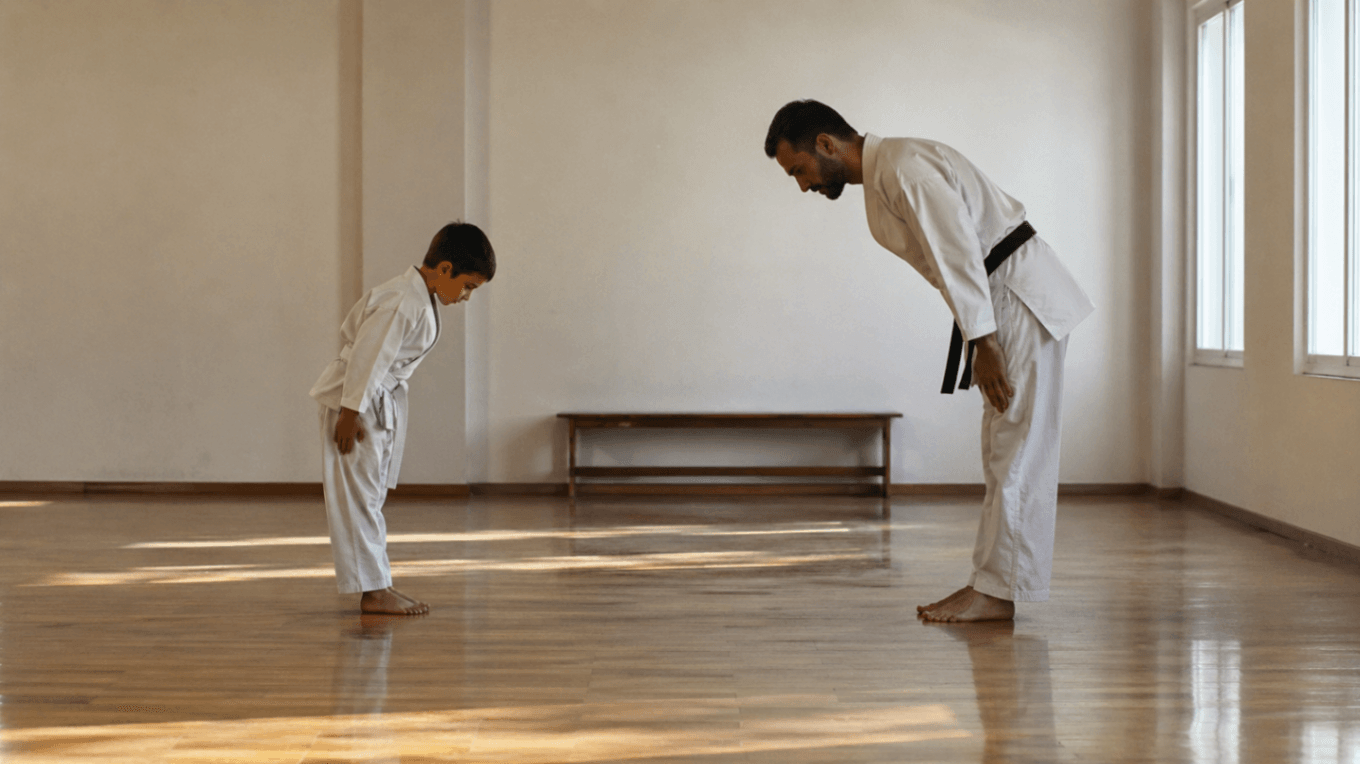
Research in the Journal of Applied Developmental Psychology found children who did martial arts for six months showed significantly greater self-regulation improvements than those in any other sport. The reason: discipline isn't a side-effect of martial arts training — it's the actual curriculum. Bowing, protocols, belt progression, respectful feedback. Every session is discipline practice.
Particularly effective for shy or anxious children. The primary relationship is with the instructor, not peers — which makes entry less socially pressured than team sports.
2. Swimming — Unique Self-Regulation Benefits
Swimming combines progressive personal mastery, physical calming through rhythmic movement, and breath control that neurologically strengthens self-regulation. Research on children with attention difficulties consistently shows swimming produces strong improvements in focus and impulse control.
3. Gymnastics — Cognitive Demand and Body Confidence
One of the most cognitively demanding children's sports. Requires simultaneous coordination, spatial awareness, strength, and precise execution of complex sequences. Builds the prefrontal cortex functions responsible for planning and working memory. Children develop an unusually complete sense of what their own body can do — which transfers directly to confidence.
Important note: the environment matters enormously. Evaluate gymnastics programmes carefully for how they handle mistakes and define success.
4. Tennis — Strategic Thinking and Emotional Regulation
Tennis combines individual accountability with reactive problem-solving against an opponent. This creates an adaptive challenge environment that builds strategic thinking and emotional regulation under pressure. In the MENA context specifically, tennis provides social access to communities that many other sports don't.
5. Athletics (Track and Field) — Clearest Feedback Loop
Times recorded to the hundredth of a second. Distances measured to the centimetre. Personal bests are completely unambiguous. This clarity of feedback makes athletics one of the most powerful environments for building the effort-improvement connection that underlies genuine self-efficacy.
6. Football — Social Integration
Football doesn't produce the strongest individual discipline gains in the research — but in the MENA context it earns its place for one reason: it's a shared cultural language that crosses every national and linguistic boundary in the region. The social integration a child gains through football is real and significant. Confidence gains are most pronounced in programmes with a developmental coaching culture rather than a winning-at-all-costs one.
Matching Sport to Personality
Shy or anxious child: martial arts or swimming — structured, instructor-led, individual entry
High energy, restless: gymnastics or martial arts — intensity with structural discipline
Social, people-oriented: team sports where peer interaction is built into the activity
Strongly competitive: individual sports with clear personal metrics
Needs external motivation: martial arts belt systems provide visible progression
Frequently Asked Questions
At what age should organised sport begin?
Informal physical play from any age. Simple organised sport from age 3–4 with developmental-stage-appropriate programmes. Competitive organised sport from age 5–6 — emphasis should be on fun and skill, not results.
My child wants to quit after a few weeks. What do I do?
Research suggests a short period of committed continuation — finishing the term — builds the resilience that's part of the developmental benefit. But persistent unhappiness beyond several weeks signals a genuine poor fit that should be addressed rather than pushed through.
Is private coaching better than group classes for young children?
For technical individual sports like tennis, swimming, and gymnastics, private coaching allows the specific corrections group classes can't provide. For martial arts and team sports, the peer group environment is itself part of the developmental benefit.
The Bottom Line
The choice of sport matters less than the quality of the environment. Observe how your child feels before, during, and after sessions — that's the most reliable measure of whether a sport is doing what you hope. Find qualified sports coaches and activity specialists on Minders Hub.