
Should Your Child Learn Arabic? A Practical Guide for Non-Arabic-Speaking Families
By Minders Hub Editorial Team | Updated April 2026
Quick Answer
Yes — and the research is clear. Bilingual children consistently outperform peers in focus, memory, and academic skills. Arabic specifically offers unique cognitive advantages, strong social value in the region, and long-term professional doors. The earlier you start, the better. But it's never too late.
It's one of the most common expat-parent debates: is it worth putting our child in Arabic lessons if we're only here a few years? Arabic is hard. The school is in English. Is it really worth it?
Here's the short answer: yes, consistently, across multiple decades of research.
The Cognitive Case — What the Science Actually Shows
A 2023 meta-analysis published in Psychological Bulletin, reviewing 152 studies and over 200,000 children, found that bilingual children consistently outperformed monolingual peers on attention control and cognitive flexibility — the same skills that drive academic performance.
Arabic has an additional unique advantage: its diglossia. Children who learn Arabic navigate two registers of the same language (Modern Standard and spoken dialect) simultaneously. Research from Hebrew University found this builds exceptional metalinguistic awareness — the ability to think about language as a system — which accelerates learning of any subsequent language.
The Social Case — Right Here, Right Now
A child who can exchange even basic Arabic greetings with a local classmate, shopkeeper, or neighbour has something that purely English-speaking children simply don't: a bridge. In a region where language carries deep cultural identity, that bridge changes daily life quality in ways that go well beyond communication.
The Long-Term Case — A Rare Professional Asset
Arabic is spoken by over 420 million people across 22 countries. Most professionals who work in the MENA region don't speak it. Those who do access relationships, trust, and opportunities that others cannot. A child who develops genuine Arabic proficiency during the critical learning window carries a professional differentiator for life.
When Should You Start?
The critical period for language acquisition runs from birth to approximately age twelve, with the most productive window between ages three and seven. Children in this window acquire language intuitively — without the explicit grammar struggle adults face.
Informal exposure: any age. Songs, greetings, stories — from infancy. Formal lessons with a tutor: from around age four or five.
Modern Standard Arabic or Dialect — Which First?
MSA (Fusha) is universal across all Arab countries and is what schools teach. Spoken dialect is what your child will actually use in daily life — and it varies by country. The best approach for most expat children: MSA as the foundation if school teaches Arabic as a subject, combined with the local dialect for social use. A good tutor holds both.
What to Look for in a Children's Arabic Tutor
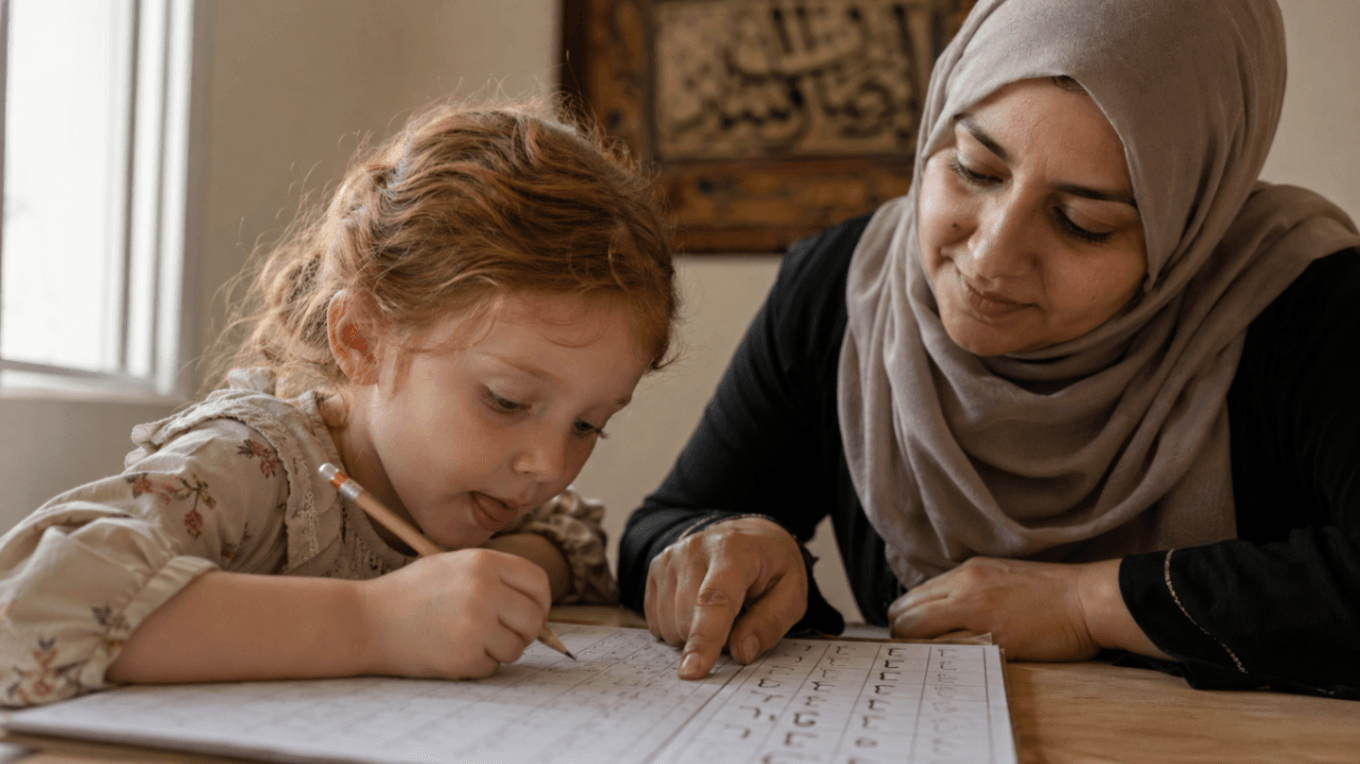
Specific experience with child learners in your child's age group
Play-based, communicative methodology for children under eight — not grammar drills
Familiarity with the curriculum your child's school uses
Proficiency in your child's primary language for early-stage instruction
Patience and positive reinforcement with beginners
Frequently Asked Questions
We might only be here two years. Is it still worth it?
Yes. Even two years during the critical period leaves neurological traces that affect language learning ability for life. Early language pathways recover quickly when reactivated — even after a long gap.
Won't multiple languages confuse my child?
No. This concern has been consistently disproved by research. Temporary language mixing during development is normal and self-correcting. Bilingualism is a cognitive advantage, not a liability.
How many sessions per week are effective?
Two sessions per week of 30–45 minutes for children under eight. Frequency reinforces retention in early language learning more than length does.
My child resists Arabic lessons. What should I do?
Try a highly game-based, communicative approach with a tutor who specialises in reluctant beginners. Setting quick achievable milestones — greeting someone in Arabic, understanding a song — can completely shift a child's relationship with the language.
The Bottom Line
Your child has access right now to an immersive Arabic environment that most people never will. The question is simply whether to use it. Find a qualified, child-focused Arabic tutor on Minders Hub — filtered by age range, methodology, and dialect specialisation.